
Klinker · Slips
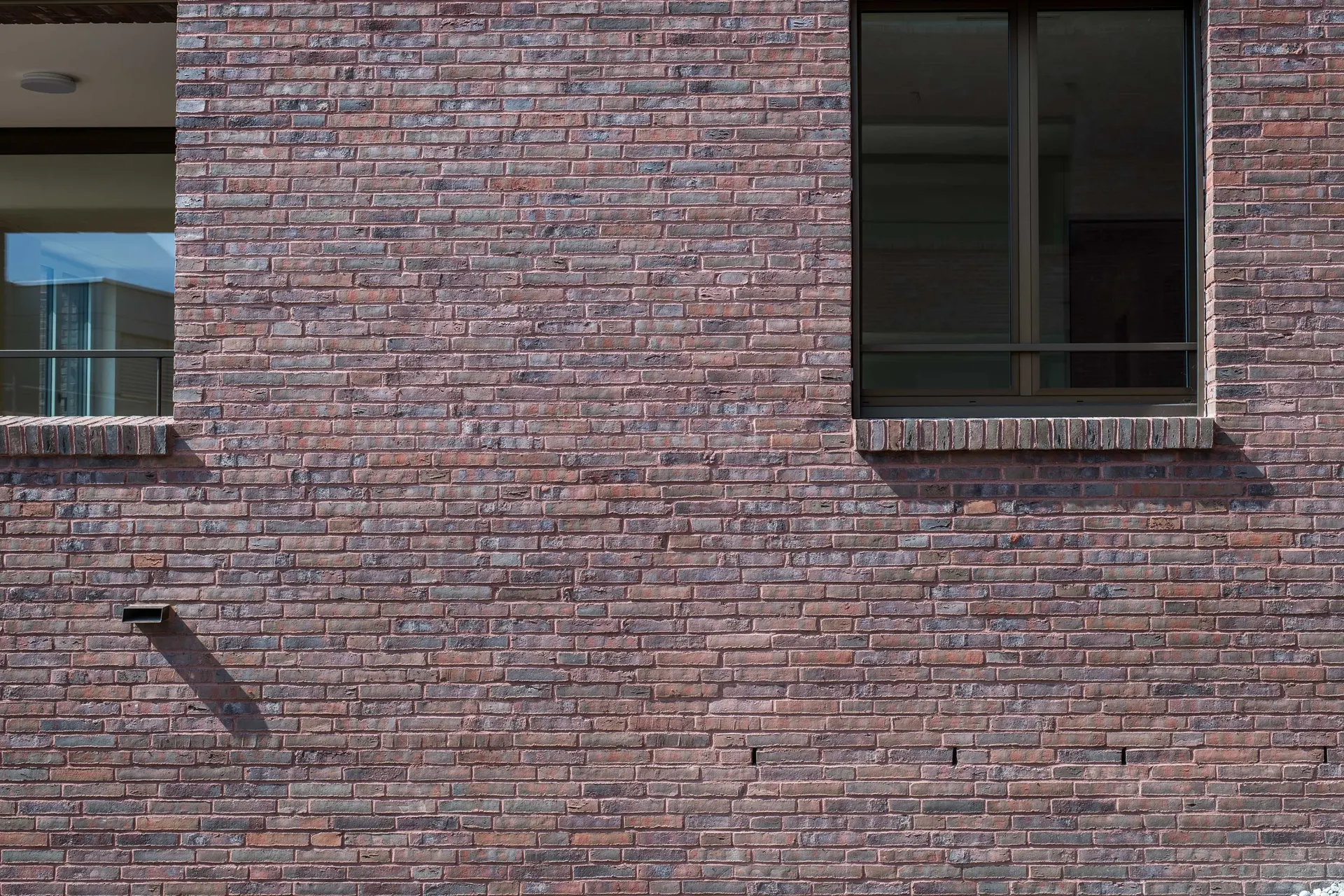
The slim klinker facade: klinker slips are bonded over the full surface onto an external thermal insulation system and then pointed. With the look of genuine exposed masonry, for new builds and renovations.
Klinker slips are thin klinker tiles, 9–18 mm thick in the standard system. They are bonded over the full surface with adhesive mortar onto the reinforced base coat of an external thermal insulation composite system (ETICS) and then pointed. The result is a slim, energy-efficient facade with the look of genuine exposed masonry.
Compared with cavity masonry, the system needs little wall thickness, no separate outer leaf and no support angles. It therefore suits new builds as well as energy renovations and extra storeys. Every bond and joint pattern from our planning manual can also be built with slips, including corners.
We plan klinker slips with the Fixit StoneEtics® 50 system from Fixit AG. Together with Fixit we provide a 10-year system guarantee, provided all system components come from Fixit. SIA 243, ETAG 004 and the SPV "Fassadenkeramik" leaflet apply first, then the Fixit guidelines and our standard details.
The build-up from inside to outside:
The standard system weighs up to 50 kg/m²; above that, a reinforced build-up with support mesh is required. The joint share should be at least 6 % and joint width preferably not below 8 mm. Movement joints divide the surface into fields about one storey high and 3–5 m wide, or 3–4 m on dark or very sunny facades.
Adhesive mortar and cementitious pointing mortar are non-combustible (RF1, A2 to EN 13501). The classification of the whole system depends on the approved ETICS. Important for tenders: a bonded slip is not masonry under SIA and is specified as ETICS. Our system comparison sets out how it differs from cavity masonry in cost, life cycle and dismantling.
| Format | L × H | Joint share at 10 mm |
|---|---|---|
| DF · Thin format | 240 × 52 mm | 19.5 % |
| 2 DF · Double thin format | 240 × 113 mm | 11.8 % |
| NF · Normal format | 240 × 71 mm | 15.9 % |
| RF · Reichsformat | 240 × 65 mm | 16.8 % |
| WF · Waal format | 210 × 50 mm | 20.5 % |
| WDF · Waal thick format | 210 × 65 mm | 17.3 % |
We sample formats and colours from our range for each project, including corners. All details in the klinker slips planning manual.
9–18 mm in the standard system. The maximum slip length is 60 cm.
Yes. Together with Fixit AG we provide a 10-year system guarantee on Fixit StoneEtics® 50, provided all system components come from Fixit.
Yes. Because they need little wall thickness and no support angles, slips on ETICS are well suited to energy renovations and extra storeys. On existing buildings we test the substrate with pull-off tests.
Boards of EPS, mineral wool or PU/PIR up to 300 mm. Mineral foam, foam glass and insulating renders are not suitable; in the splash zone EPS or XPS is used.
Slips on ETICS are slimmer and lighter and need no support angles. Cavity masonry is more solid and durable and offers full design freedom. Our system comparison contrasts both in construction, cost and life cycle.
Next Step
We advise you on colour, format and bond, and bring sample bricks to your office or welcome you to our showroom in Gisikon.